what issue does calibrating an inkjet printer allow you to correct?
As designers, we don't have the luxury of talking about colors figuratively. Our globe is mostly RGB, CMYK or hexadecimal, with regular trips to HSB.
Information technology might non sound fun but information technology's a serious concern. Working with color is an essential part of the graphic blueprint manufacture and mistakes with colour can exist a big fiscal loss in the print manufacture.
And so let'south see what usually goes wrong with it.
1. Working with an erstwhile or cheap monitor
Is your monitor upwardly to date?
Beginning things first. You cannot look to have good color reproduced on a monitor which wasn't designed for professional use or is simply too one-time to get colors and brightness values correct.
While nearly monitors tin can be used for gaming and concern purposes, they're not created with professionals like you in listen. They use cheap electronics and cheap display technologies with only one purpose in mind – getting a big, flashy price sticker in local electronics shop. You can imagine how much they care nigh color and shelf life.
That'due south exactly why you demand to ignore everybody and become a big, pricey screen virtually people are afraid to look at. Yous become to see colors nobody else has seen earlier and you lot get to be famous in the neighborhood. Yay!
ii. Not calibrating your monitor
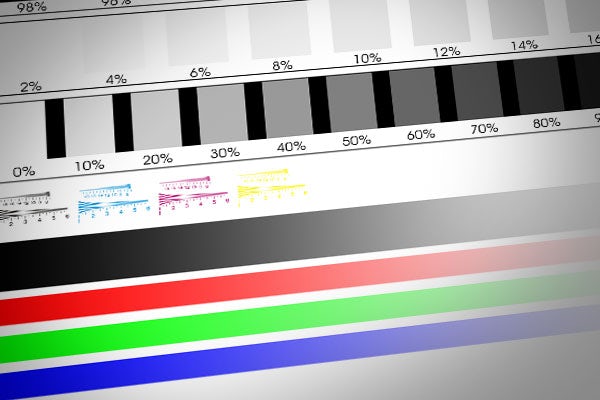
If your monitor uses arbitrary color settings like, "Movies," "Text" or "Gaming," it's time to meet calibration.
Calibration is the process of getting your monitor to bear witness the widest range of colors and grey tones, and so you become to see things the mode they were meant to exist seen. Basically, you have to divorce your personal tastes in brightness and contrast, set monitor temperature to 6500 degrees Kelvin so tweak the display settings until they match the rules you read on screen.
About modern, high-end monitors come factory calibrated then you lot don't need to do much but it costs zero to check if your settings are good.
Here's an article explaining how to calibrate monitor in Windows and here's one showing the aforementioned thing for Mac. Yous can also utilize simple online monitor calibration tools, such as this one.
The best part? If your clients complain well-nigh the colors on their monitor, you lot'll know information technology's a calibration issue.
iii. Messing with colour profiles
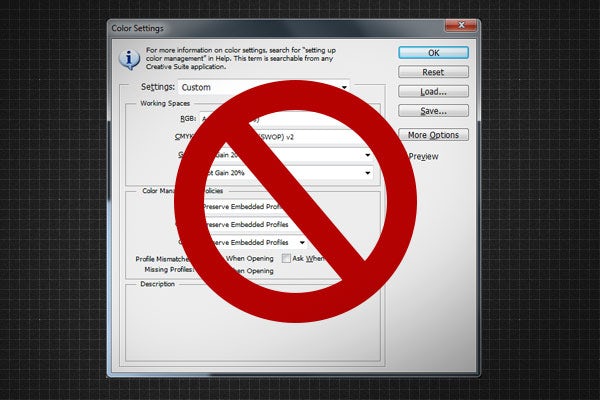
Do not alter default color profiles in your design applications unless you know EXACTLY what you want to acomplish.
Unless you're absolutely sure what you're doing, never alter the default Spider web, Impress and other color profile settings which come up with Photoshop, Illustrator or CorelDRAW.
If yous're using contempo versions of these applications, their color profiles are already fix to embrace 99% of scenarios and provide y'all with the best possible colour reproduction across a range of devices. In that location's niggling reason to dabble with that, unless y'all're very experienced in colour management and know exactly what you want to do. Even then the benefits are debatable.
The only conclusion you lot need to make is whether y'all're working for Web or Impress, then tell your awarding when creating a new document. Get out the color profiles as they are and you lot'll be happy you did.
4. Designing for print without color proofing turned on
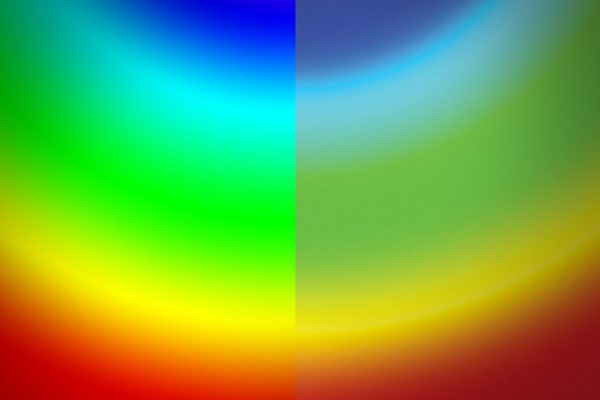
Unless color proofing is turned on, you lot will never know what your colors will expect like when printed (shown on the right)
Compared to your monitor, your printer is like a cheap telescope next to a Hubble. They might be looking at the aforementioned thing simply one will e'er prove a lot more.
Digital devices have a much wider color range than printers, which is why your colors always expect better on screen than printed.
By turning colour proofing on inside your design awarding, you lot will be able to view how printers run into your piece of work while you're designing, and then yous avert costly mistakes and disappointments. For Photoshop and Illustrator, it's as simple equally going to View and checking "Proof colors."
5. Not doing concrete print proofs
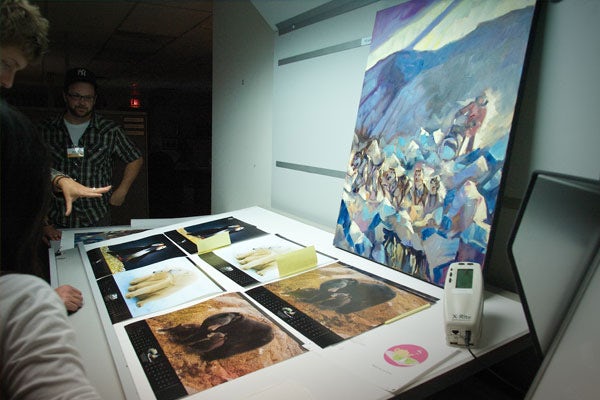
If y'all're creating artwork for print, the biggest mistake you can make is not related to RGB, CMYK, calibration, color profiles or anything fancy similar that. Information technology'south forgetting to practise a existent impress proof of your design.
A print proof is simply a digital printout of your design which shows how you look the colors to await when they come off the printing press. Why practice it? You get to see color issues early and avoid that two hour give-and-take near the printing job going bad.
The best case scenario, you create a print proof on a high-end laser color printer with print-proofing setting, then submit it to a professional person printer along with your digital files. Most small print shops will be able to create a print proof for yous but if yous don't find one, fifty-fifty a expert inkjet copy will do.
The fundamental bespeak is to show the printer what you lot want the colors to look like, and then they can make necessary adjustments in gild to friction match them, instead of trying to read your mind.
6. Designing in CMYK color mode (Photoshop)

Yes, you read this correct – designing in CMYK mode in Photoshop is not the best style to go when it comes to print work. And no, I'm not crazy.
While CMYK color way is required for press, using it during design time is actually very limiting. Many Photoshop filters and functions do not work in CMYK way, the functioning is slower and your file size gets bigger.
For this reason, it'south ever best to work in RGB mode with Colour proofing on, then convert the document to CMYK in one case it's finalized.
You get the same results but better and faster application performance.
7. Using default colour palette
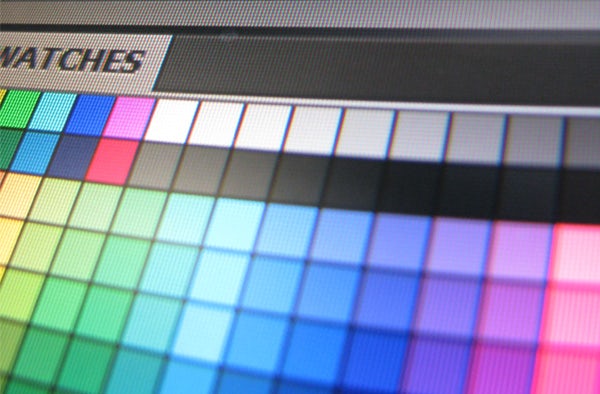
Most of the color mistakes mentioned earlier were technical in nature but this one is creative.
Yous should rarely, if ever, design your work with default color swatches provided by the application. These simple, saturated colors limit your piece of work to a very small number of colour choices and prevent you from exploring more attractive combinations.
If you need proof, pay attention to logo and website colors in the next contest – you'll see many of them come up straight out of default swatch factory.
Don't be lazy. Apply tools such as Adobe Kuler or Colour Hunter to pick an original and expressive color palette even before you start designing. You'll be amazed how beautiful and original your work of a sudden starts to wait.
eight. Non using the HSB color mixer
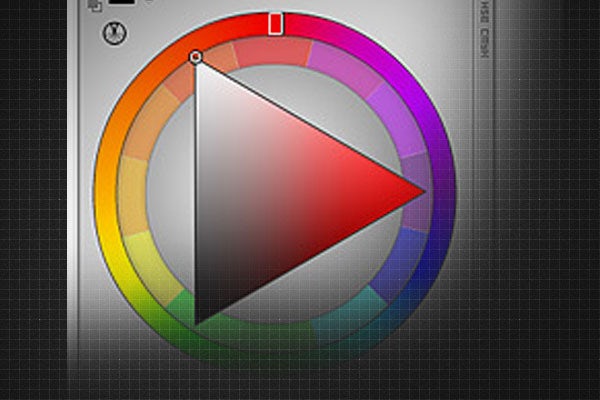
The HSB color mixing so essential to professional designers that even special Photoshop plugins get developed specifically for this purpose.
Quick exam: how do you make a chocolate-brown color more vibrant using RGB or CMYK sliders? You have no idea — neither do I.
When you commencement thinking in HSB terms, the respond is simple: you increase the saturation.
HSL, or Hue-Saturation-Brightness color mixing was invented to help designers and visual artists choice colors in an easy and intuitive mode.
The idea is simple:
- Hue sliders let you pick the general tone of colour
- Saturation sliders allow yous decide how much it "pops," or how stake or stiff information technology is
- Brightness sliders lets yous decide on the amount of light — whether information technology'due south bright as twenty-four hour period, or nighttime every bit night
When clients tell you, "This blue should exist a bit more than pale and brighter," you immediately know you need to do two things: decrease saturation and increase effulgence.
Starting time thinking in HSB terms, and y'all'll go to know color.
Color bug summarized
Most of the colour issues we face up today come from very small-scale and tiny mistakes in our workflow. The monitors and printers we have today are more than capable of working together smoothly merely if you fail to calibrate, color proof or only pick a good looking palette, your work isn't going to look the best that it can.
The advice in this article covers some basics merely ultimately, every designer ends upward with his own ready of tricks to deal with color.
How do yous handle colour while designing? Please share.
Featured image: Supernico26 (via Flickr)
Source: https://99designs.com/blog/tips/8-common-mistakes-in-working-with-color-and-how-to-fix-them/
0 Response to "what issue does calibrating an inkjet printer allow you to correct?"
Post a Comment