What Is the Relationship Between Art and Status in Ancient Rome
Ancient Roman Course Structure
Aboriginal Rome was a kind of social club where class structure not only existed simply was strictly enforced. In a style, this was natural for a society which consisted of a sizeable number of slaves and where people from dissimilar ethnicities lived. Various factors were considered decisive in determining the condition of a costless Roman in social club. These factors included ancestry, demography rank based on wealth and political privilege, attainment of honours, and citizenship of which in that location were various grades. Further classes included those of non-citizens and slaves.
The population of ancient Rome continued to ascent and decline due to diverse reasons. At the meridian of the empire in 160 AD, the population of Rome has been estimated to exist nearly 60 million with a population density of 16 people per foursquare kilometre. Rome likewise had a very loftier rate of urbanisation compared to other societies of the same period. At the height of the empire, the population of the city of Rome has been estimated to exist more than than ane million which remained the highest population in a European city till the nineteenth century.
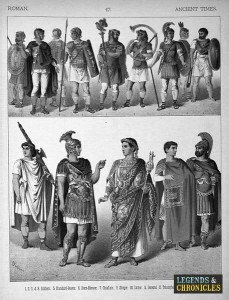
Examples of many classes from ancient Roman times.
Looking at the history of ancient Rome, yous can see the class structure seems to have existed from the very early days of Rome. In the days of the Roman Kingdom, the almost crucial stardom in the Roman society was between the patricians and the plebeians. Patricians were the elite who held the political, authoritative, and armed services power and who were idea to accept been descended from the start senate established by the founder of Rome, Romulus. Plebeians, on other manus, were the rest of the mutual citizens. This distinction included only the males with the status of slaves, women, and children being much less.
Roman citizens
Roman citizenship was divided into various types which likewise reflected the ancient Roman grade structure. The male citizens enjoyed the widest range of privileges only under certain circumstances, he could also be deprived of his citizenship.
Women in these times were given a limited course of citizenship and did not accept the right to vote or agree any public office. Women, however, had certain legal rights such as the right to own property, the right to obtain divorce, and the correct to practise business.
Slaves of ancient Rome did not have any legal rights and were entirely at the mercy of their masters. Freed slaves, however, had express rights and their children were considered gratis citizens of Rome.
Upper and lower classes
The distinction between the upper and lower classes was articulate in the ancient Roman course structure. Patricians were the upper class people who wielded political and authoritative power and enjoyed wealth. Lower classes, known as plebeians, indulged in all sorts of piece of work merely did not have the political and administrative power of the upper classes. However, it was possible for members of the plebeian class to become the political elite. For instance, Roman Emperor Augustus was of plebeian origin.
Upper classes
The ancient Roman elite structure revolved around the patricians. The patricians wielded the political power and were e'er better represented in the Roman assemblies. The patricians dominated the political scene for centuries because they were always in majority in the senate. Further, at the first of the republic, only patricians could enter priesthood but that changed effectually 300 BC.
Lower classes
The lower classes consisted of the plebeians who could attain material wealth but did not savor the political ability. This included average working-course people who indulged in all sorts of ordinary professions including farming and labouring. There was a client-patronage human relationship betwixt many patricians and plebeians where the plebeians pledged their respect and favour in render for political and legal assistance from the patricians. Slaves in the Roman course structure did not accept any legal rights and were entirely dependent on their masters.
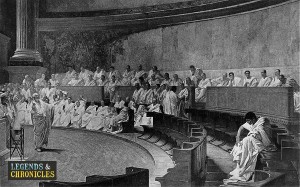
The upper class of Rome were typically involved the politics and decision making processes.
Equestrian class in ancient Rome
Autonomously from the distinction between the patricians and plebeians, at that place was a very of import stardom between the senatorial class and the equestrian class in ancient Rome. The senatorial class consisted of all the men who served in the senate and wielded political ability. Equestrian class, on the other manus, was of economic importance and any homo who could evidence that he possessed a certain amount of wealth could be enrolled in the equestrian gild. It was besides possible for a fellow member of the equestrian class to get a senator, in which case he became a member of the senatorial form.
Women and men in Roman society
The status of men was clearly much higher than women in the ancient Roman class construction. Men were the citizens who enjoyed all the political and social privileges in the public every bit well as private life. Women, on the other mitt, did non accept a right to vote and could too not concur whatsoever public office. Nonetheless, they were immune to do business organisation, to own state, and to obtain divorce if they and then wished. The rights of women were quite restricted compared to the rights of men in ancient Rome.
Roman royalty in Roman gild
The emperor was at the top of the hierarchy of aboriginal Roman class construction. The royalty was inherited and thus remained within the aforementioned family until some war caused a change in the ruling family unit. The emperors from Augustus in 14 Advertisement until the emperor Commodus in 192 Advertisement hailed from the same extended family. After that, for a cursory period of virtually twoscore years, several families ruled Rome, often ambivalent with each other.
A summary of the Roman class structure
The class structure was an integral characteristic of the ancient Roman society. It was a conspicuously defined categorisation of the population of Rome based on their political privileges and social status. In this hierarchy of ancient Rome, the emperor was at the acme and then came the patrician form which held the political and authoritative power. Mutual people brutal in the category of plebeians who could amass wealth but did not bask direct political ability that others did.
It was entirely possible for the Roman people to alter their social standing in society. For instance, the slaves who were freed obtained sure rights and their children were considered free Roman citizens. The famous poet Horace, for example, was the son of a freed slave. Similarly, plebeians could obtain wealth and even political power while some patrician families roughshod into poverty during the middle and late Roman republic.
Source: https://www.legendsandchronicles.com/ancient-civilizations/ancient-rome/ancient-roman-class-structure/
0 Response to "What Is the Relationship Between Art and Status in Ancient Rome"
Post a Comment